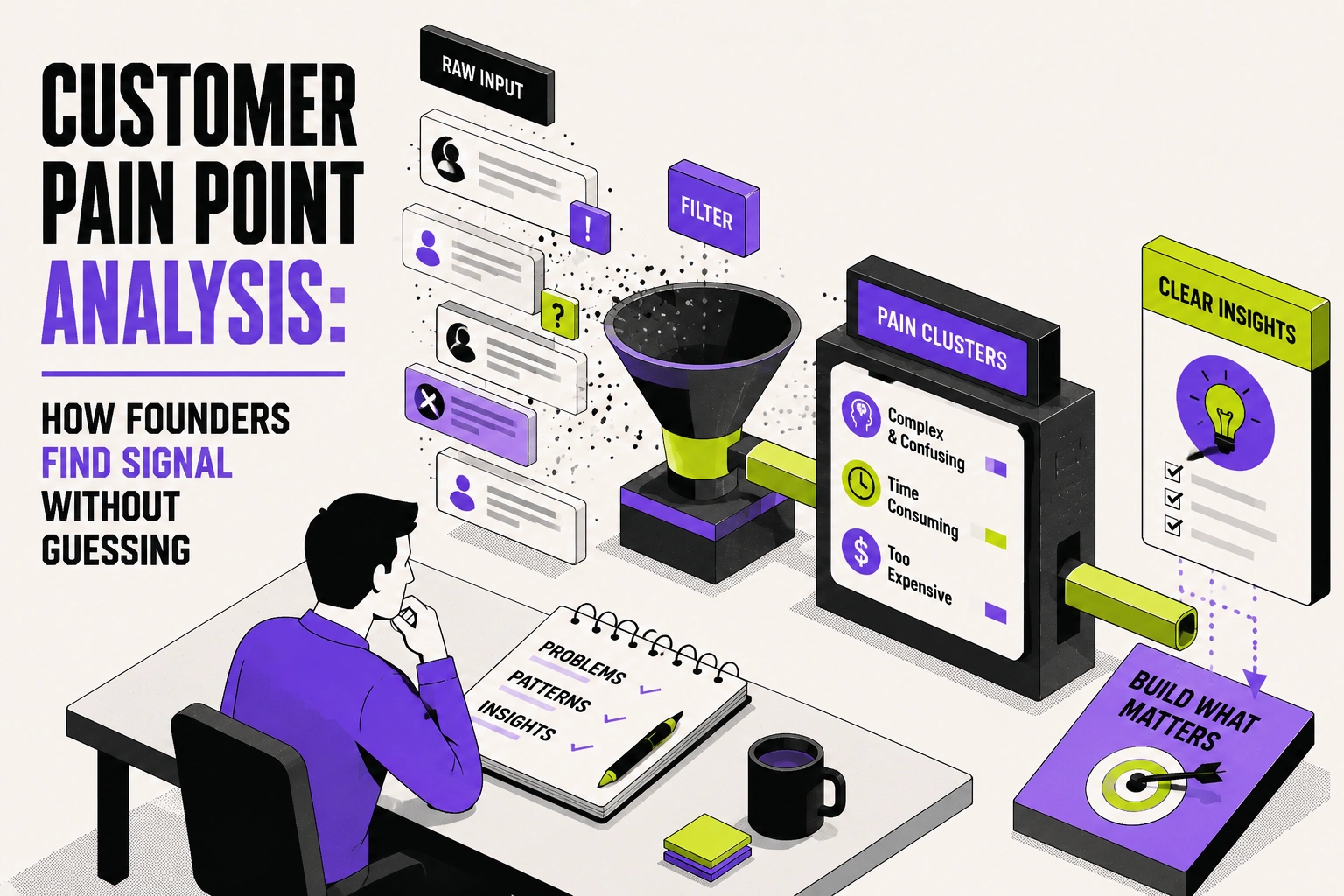
Customer pain point analysis helps founders figure out which frustrations are real, which ones are repeated, and which ones actually deserve product attention. That matters because not every complaint matters equally. Some issues are minor annoyances. Others are strong signals that people are ready for a better solution.
The goal is not to analyze every comment or every complaint. The goal is to separate noise from recurring pain so you can make better product, messaging, and positioning decisions.
This guide explains what customer pain point analysis is, how to do it, what to look for, and when a product-focused workflow like ReddMatch helps you move faster.
If you want the Reddit-specific version of this topic, reddit market research and reddit customer research are the best companion articles. If you want to go from pain to a thread worth acting on, reddit lead discovery is the next layer.
What Customer Pain Point Analysis Actually Means
Customer pain point analysis is the process of studying feedback to understand what frustrates buyers, what they are already doing instead, and what outcome they want.
It is different from reading feedback just to stay informed.
Good analysis answers questions like:
- What is the problem?
- How often does it show up?
- What do people call it?
- What workaround do they use?
- What would make it worth changing?
Those questions matter because pain only becomes useful when you understand its shape.
A loud complaint is not always a useful one. Repeated pain is usually the signal worth paying attention to.
That is also why reddit market research and reddit audience research fit naturally into this workflow. They help you see the broader context around the pain.
Why Founders Use Pain Point Analysis
Founders use pain point analysis because the market rarely explains itself cleanly.
People describe problems in different ways. They hide frustrations inside casual comments. They mention workarounds without calling them workarounds. They compare alternatives before they ever say they are shopping.
That means the useful work is not just collecting feedback. It is deciding what the feedback really means.
| What you learn | Why it matters |
|---|---|
| Repeated frustration | Shows whether the pain is real or isolated |
| Workarounds | Shows what people already tolerate |
| Buying language | Helps with copy and positioning |
| Change triggers | Shows what might push someone to switch |
If you already read reddit intent data, this will feel related. Pain point analysis helps you understand the problem itself before you decide whether the signal is strong enough to act on.
A Simple Example
Imagine you build a tool for small teams managing customer follow-up.
You might see pain expressed in a few different ways:
- "We keep forgetting to reply."
- "Our spreadsheet is getting out of hand."
- "We have no process for tracking this."
- "We are still doing this manually."
Those are all different sentences, but they point to the same underlying pain.
That is the real job of analysis: connect the wording to the problem.
How To Do Customer Pain Point Analysis
You do not need a complicated process.
- Collect feedback from the places your buyers already talk.
- Group similar complaints together.
- Look for repeated phrasing.
- Note what people are doing instead.
- Mark the moments when frustration becomes urgent.
- Compare the pain across different sources.
- Decide which pains are strong enough to matter.
That keeps the analysis grounded in evidence instead of intuition.
What To Look For
The strongest pain point signals usually show up in a few forms.
1. Repetition
If the same complaint appears again and again, that matters.
2. Workarounds
People often reveal pain by describing what they built or hacked together.
3. Frustrated language
Words like "annoying," "waste of time," "manual," or "hard to track" are useful clues.
4. Comparison behavior
If people are comparing alternatives, they are already thinking about change.
5. Outcome language
What do they want instead? That tells you what the pain is really blocking.
Broad Analysis Vs Source-Specific Analysis
Customer pain point analysis can be broad or source-specific.
| Approach | Best for | Tradeoff |
|---|---|---|
| Broad analysis | Finding repeated pain across the market | Requires more filtering |
| Reddit-specific analysis | Learning from community conversations | Only covers one source |
| Tool-assisted analysis | Filtering and prioritizing faster | Depends on tool quality |
If your buyers spend time on Reddit, the Reddit-specific path is especially useful. If they do not, the same analysis still works elsewhere.
Common Mistakes
Treating a complaint as a signal
A complaint only matters if it shows up more than once or affects buying behavior.
Ignoring workarounds
Workarounds tell you what people already accept.
Confusing noise with urgency
Not every complaint means someone is ready to switch.
Overfitting to one source
The same pain can look different depending on where it is expressed.
Skipping the comparison step
If you do not compare patterns, you miss what actually repeats.
The value comes from pattern recognition, not from finding a single dramatic example.
How ReddMatch Fits Into Pain Point Analysis
ReddMatch is built for founders who want to find Reddit conversations related to the problems their product solves.
You create a project from your website URL, and ReddMatch analyzes the product context so it can match relevant Reddit conversations to your feed. That makes it easier to spot recurring pain inside the right threads instead of searching manually every time.
New matching conversations continue to appear in your personalized feed over time, so the workflow keeps going after the first search.
Each lead includes structured context like:
- pain summary
- desired outcome
- poster context
- intent type
That makes it easier to compare pain across conversations and decide what matters.
ReddMatch also includes Reply Strategy. It recommends the best approach, explains why it fits, and gives you talking points. You still write the final reply yourself.
That matters because good pain analysis should lead to better judgment, not more noise.
Best Practices For Founders
If you want customer pain point analysis to stay useful, keep it simple.
- Focus on repeated frustrations.
- Save the exact words people use.
- Track workarounds and objections.
- Compare sources before deciding.
- Revisit the same pains over time.
Good analysis should make the market feel clearer.
FAQ
These are the questions founders usually ask when they start doing customer pain point analysis.
Conclusion
Customer pain point analysis helps founders focus on the frustrations that actually matter.
If you can identify repeated pain, the words people use, and the workarounds they rely on, you get a much better read on where the opportunity is.
If you want a Reddit-focused workflow for finding and reviewing those conversations, ReddMatch can help you surface relevant threads, understand the context, and focus on the pain signals that matter.
If you want the broader research layer, read reddit market research next.














Comments on this page